Monday, August 25, 2008


Saturday, May 24, 2008
Russia national football team

After Euro 96, Boris Ignatyev was appointed manager. His goal was to lead Russia to the 1998 FIFA World Cup in France. He used many rising stars from Euro 96 like Viktor Onopko, Aleksandr Mostovoi, and Valery Karpin. In the qualifying stage Russia was in group 5 with Bulgaria, Israel, Cyprus, and Luxembourg. Russia and Bulgaria were considered the two main contenders to qualify from the group with Israel considered a minor threat. Russia were determined to qualify for the 2000 UEFA European Championships in Belgium and the Netherlands. Manager an Soviet footballing legend Anatoliy Byshovets was appointed as Russia manager. Byshovets made very little changes to squad by recalling players from the previous generations.
On April 10, 2006, it was announced that then Australia manager Guus Hiddink would lead Russia in the Euro 2008 qualification campaign. For the Euro 2008 qualifying campaign. Russia were drawn into group E with England, Croatia, Israel, FYR Macedonia, Estonia, and Andorra. Led by Guus Hiddink, Russia began their Euro 2008 campaign poorly by drawing with Croatia 0-0 and Israel 1-1 at home. In the Euro 2008 final tournament, Russia were drawn into Group D with Sweden and Euro 2004 group rivals Spain and Greece.
European Championship record :
1996 - round 1
2000 - did not qualify
2004 - round 1
2008 - qualified
Spain national football team


Under French-Argentine coach Helenio Herrera, Spain came out of a period of wilderness to qualify for the first European Championship in 1960. At Euro 60, Spain entered into the quarter finals and beat Poland 7-2 on aggregate. However, after a protest against the USSR, Spain was automatically knocked out of the competition. In 1962 José Villalonga was appointed coach of Spain. Two years later they won the European Championship. With a squad that included Luis Suárez, Francisco Gento, Josep Fusté and José Ángel Iribar, Spain beat Romania, Northern Ireland and the Republic of Ireland in the qualifying rounds before hosting the semi-finals and final. The departure of Villalonga put Spain into another period of wilderness with mixed results. They were knocked out by England in the quarterfinals of the 1968 European Championship knockout stages and did not make it to the final tournament held in Italy. Spain did not qualify for another tournament until Euro 76. Spain ended a period of wilderness with an impressive undefeated performance in their Euro 76 qualifying group which featured Romania, Scotland, and Denmark. Spain exited in the quarterfinals having been defeated by Germany 3-1 on aggregate. Euro 80 saw Spain qualify for the first eight-team European championship. After suprassing Romania, Yugoslavia, and Cyprus, Spain was drawn into group B with England, Italy, and Belgium. Spain proved to be the weakest side of the group as they gained only one point after a draw with Italy and losses to England and Belgium.
After a 3-2 opening defeat to Cyprus in Euro 2000 qualifying Clemente was sacked and José Antonio Camacho was promptly appointed as coach. Camacho immediately turned Spain's campaign around and Spain won the rest of their games to qualify for Euro 2000. Once again Spain's hopes rested on a new coach and young players such as Raúl González, Fernando Morientes, Míchel Salgado, and Juan Carlos Valerón.
EURO 2004
At Euro 2004 in Portugal, Spain were drawn into group A with Portugal, Russia and Greece. After coming into second after Greece in qualifying, Spain looked very strong. The Spanish team were touted as heavy favorites for the 2004 crown by the European media. They possessed new and fresh players such as Fernando Torres and Xabi Alonso under new coach Iñaki Sáez. Spain were also hoping that the tournaments proximity would contribute to their success. On June 12th, Spain expectedly defeated Russia, 1-0, the goal scored by Juan Carlos Valerón just 36 seconds after coming on with various opportunities to increase the victory, such as a miss kick from Joseba Etxeberría against a virtually open goal, and a disallowed goal from Xabi Alonso for tapping the ball with his hand after heading it over Sergei Ovchinnikov. Four days later Spain faced Greece. Determined to win, Spain led the match until Greece scored an equalizer and the match ended 1-1. In their last game against Portugal, Spain needed to draw to qualify for the quarterfinals. However, a goal from Nuno Gomes faded Spain's hopes of advancing. The same day Greece were defeated 2-1 by Russia but moved ahead to claim second place on goal difference. As a result Spain were eliminated from Euro 2004 in the first round that consisted of the tournament's eventual finalists in Portugal and Greece. This exit was considered the most disappointing result since the 1998 World Cup. Iñaki Sáez was sacked only weeks later and replaced by Luis Aragonés.
EURO 2008
Spain started its qualifying round on September 2, 2006 for Euro 2008 by beating Liechtenstein 4-0 in Badajoz. But were then upset by Northern Ireland 3-2 in Belfast on September 6, 2006. A second straight defeat - a 2-0 loss to Sweden - followed on October 7, 2006. However a 2-1 win against Denmark on March 24, 2007 in Madrid along with a goal from Andrés Iniesta giving Spain a 1-0 victory at home to Iceland on March 28, 2007 has put new life into Spain's campaign. On June 2 they won 2-0 at Latvia and four days later they won against Liechtenstein 2-0. Both goals were scored by David Villa in that game. Spain's hopes for a 5-match winning streak were halted at Reykjavik, when Iceland held Spain to a 1-1 draw. Iniesta managed to save the point for Spain after he scored a late goal in that match. Their winning ways resumed at Oviedo, when Xavi and Torres gave Spain a 2-0 win against Latvia. Spain's next opponent was Denmark, who they defeated 3-1 at Aarhus, a result that is expected to be definitive for the Spanish team's chances to qualify for the final round of the European Championships. On November 18, 2007, Spain beat Sweden 3-0 with goals from Joan Capdevila, Andres Iniesta, and Sergio Ramos, qualifying themselves for Euro 2008. On 21 November, they got revenge on Northern Ireland by beating them 1-0, thereby ruining their chances of qualifying.
In preparation for the tournement, manager Luis Aragonés spoke confidently of Spain's chances to make it out of their group, "Sure, it's going to be easy for us; all we have to do is to beat Sweden who historically have better results than us, down Greece who are the reigning champions and then Russia and all that will be easy"
European Championships record :
1960 - did not qualify
1964 - champions
1968 - did not qualify
1972 - did not qualify
1976 - did not qualify
1980 - round 1
1984 - runners up
1988 - round 1
1992 - did not qualify
1996 - quarter final
2000 - quarter final
2004 - round 1
2008 - qualified
Sweden national football team

European Championship :
1960 - did not enter
1964 - did not qualify
1968 - did not qualify
1972 - did not qualify
1976 - did not qualify
1980 - did not qualify
1984 - did not qualify
1988 - did not qualify
1992 - semifinal
1996 - did not qualify
2000 - round 1
2004 - quarterfinal
2008 - qualified
Greece national football team
Greece made its first appearance in a major tournament at the Euro 1980 in Italy after qualifying as first - under the guidance of Alketas Panagoulias- from a group that included USSR and Hungary, both world powers back then. In the final tournament, Greece was drawn into group A with West Germany, the Netherlands, and Czechoslovakia.
Greece was the highest ranked seed in the 'pots' for qualification to the UEFA Euro 2008 in Switzerland and Austria and was drawn with Turkey, Norway, Bosnia and Herzegovina, Hungary, Moldova and Malta being the only group which did not have a team represented in the World Cup 2006. Greece began their Euro 2008 campaign with victories over Moldova, Norway and Bosnia-Herzegovina.
European Championship record :
1960 - did not qualify
1964 - withdrew from qualifying
1968 - did not qualify
1972 - did not qualify
1976 - did not qualify
1980 - round 1
1984 - did not qualify
1988 - did not qualify
1992 - did not qualify
1996 - did not qualify
2000 - did not qualify
2004 - champions
2008 - qualified
France national football team

Euro 2000
Jacquet stepped down after France's World Cup triumph and was succeeded by assistant Roger Lemerre who guided them through Euro 2000.
Euro 2004
A full strength team started out strongly in Euro 2004, with Zidane scoring a free kick and a penalty to overcome a 0-1 deficit and defeat England in the group stage, but they were upset in the quarter-finals by the eventual winners, Greece. Jacques Santini resigned as coach and Raymond Domenech was picked as his replacement.
Euro 2008 Qualifiers
France started its qualifying round for Euro 2008 on September 2, 2006 by beating Georgia in Tbilisi 3-0.
European Championship record
1960 - semifinal
1964 - did not qualify
1968 - did not qualify
1972 - did not qualify
1976 - did not qualify
1980 - did not qualify
1984 - champions
1988 - did not qualify
1992 - round 1
1996 - semifinal
2000 - champions
2004 - quarterfinals
2008 - qualified
Famous past players :
Fabien Barthez
Laurent Blanc
Eric Cantona
Marcel Desailly
Didier Deschamps
Youri Djorkaeff
Bixente Lizarazu
Ludovic Giuly
David Ginola
Christophe Dugarry
Emmanuel Petit
Robert Pirès
Michel Platini
Zinedine Zidane
Romania national football team

European Championship record :
* 1960 to 1980 - Did not qualify
* 1984 - Round 1
* 1988 to 1992 - Did not qualify
* 1996 - Round 1
* 2000 - Quarterfinals
* 2004 - Did not qualify
* 2008 - Qualified
Famous players :
Cristian Chivu
Cosmin Contra
Bogdan Lobonţ
Dorinel Munteanu
Adrian Mutu
Marius Niculae
Top goalscorers :
Gheorghe Hagi 1983 - 2000 35 (125)
Adrian Mutu 2000 - present 27 (60)
Viorel Moldovan 1993 - 2005 25 (70)
Saturday, May 17, 2008
Croats and Carson leave England shattered in Euro 2008 football
Having fought back from conceding two goals inside the first quarter of an hour to get to within 13 minutes of the draw that would have taken them to Austria and Switzerland, England saw their qualification hopes shattered by Petric's 25-yard shot.
It was a defeat that has almost certainly ensured that McClaren's 15-month reign as England manager will come to an abrupt end.
But when asked if he would resign McClaren told Sky News: "No. I have no intention of doing that. I pick the team and said over the 12 games I would be judged and I will be.
"Obviously it's not for me to decide, I'm not discussing anything at this present moment.
"I am not looking to the future, I am thinking about this game, what could have been, what wasn't, and really how we get over this."
Having opted to axe his usual first-choice goalkeeper Paul Robinson, McClaren had to watch in disbelief as a horrendous blunder by Carson on his first competitive appearance for his country gifted Niko Kranjcar a goal after only seven minutes.
Ivica Olic then doubled Croatia's lead and despite a fightback that yielded a Frank Lampard penalty and an equaliser from Peter Crouch, England could have little complaint about the final outcome.
Israel's last-minute winner against Russia may have reduced the scale of England's task but it was one that had to be accomplished in the absence of Wayne Rooney, Michael Owen and the first-choice centreback pairing of Rio Ferdinand and John Terry.
There was no place for David Beckham in the improvised starting line-up that resulted, McClaren opting instead for the pace of Shaun Wright-Phillips.
A bright start by the Chelsea winger suggested the hapless manager may have got that judgement right but it only took a little over seven minutes for the gamble inherent in his other big selection call to be exposed.
Kranjcar did not appear to represent any great danger as he picked up a crossfield pass in the inside left channel, nearly 40 yards from goal.
And although he was able to sidestep Micah Richards with ease, the Portsmouth midfielder could never have expected that a hopeful shot struck only slightly to Carson's left would would find the back of the net.
That it did may have been partly due to the fact that it spun off the sodden turf just in front of the goalkeeper, but he will be judged harshly for failing to get his body properly behind the ball.
England's predictably furious response should have yielded an equaliser three minutes later but, after an incisive run by Joe Cole and a deft lay-off from Crouch, Wright-Phillips placed his shot from 12 yards straight at Stipe Pletikosa in Croatia's goal.
Another chance went begging -- Crouch failing to connect cleanly with a low cutback from the overlapping Richards at the near post -- before Croatia produced a clinical counter-attack to claim a two goal lead inside quarter of an hour.
Eduardo Da Silva was the architect. An aerial one-two with Olic on the half-way line allowed the Arsenal forward to advance to the edge of the area before slipping a pass between Sol Campbell and Joleon Lescott.
Olic had continued his run and the quality of Eduardo's pass ensured he barely had to break his stride as he went round Carson and tapped the ball into the empty net.
The extent of the goalkeeper's stage fright was underlined three minutes before the break, when he spilled a shot from Luka Modric.
By that stage, McClaren had no option but to try something different and it was no surprise that Wright-Phillips and Gareth Barry made way for Beckham and Jermain Defoe at the interval.
Beckham's entry in particular appeared to rally the home supporters back behind their team and England got the break they needed 11 minutes into the second half, when Josip Simunic needlessly tugged at Defoe's shirt as he chased a Joe Cole cross, handing Lampard the chance to send Pletikosa the wrong way from the spot.
The tide was turning England's way but they still required Carson to partially redeem himself for his first-half error with a superb reflex save to keep out Olic's powerful header from a corner that had been conceded by a Wayne Bridge clearance that shaved the top of his own crossbar.
The outstanding Olic forced another good save from the Aston Villa goalkeeper after dispossessing Bridge on the edge of the box before England got back on level terms with 25 minutes left.
An interception by Richards gave Beckham the time to lift his head and find Crouch, who took the ball on his chest and volleyed in his 14th goal in 24 England appearances from close range.
Suddenly England looked safe but they had reckoned without the desire of Croatia's substitutes to make their mark at Wembley.
With 13 minutes left, Petric took a pass from Dnijel Prajic and, from 25 yards out, fired a shot across Carson and into the opposite corner of the net. This time there was no way back for England.
source : www.turkishpress.com
Italy national football team
 The Italian national football team (Nazionale italiana di calcio) is controlled by the Federazione Italiana Giuoco Calcio (FIGC) and represents Italy in international football competition. To this tally they can add one European championship (1968), two Central European International Cup and one Olympic Gold Medal (1936). The traditional colour of the national team (as well as of all Italian teams and athletes except red used in motor sports) is azure blue[1] (azzurro, in Italian), due to the "Azzurro Savoia" (Savoy Blue), the colour traditionally linked to the dynasty which unified Italy in 1860. Therefore national team members are nicknamed Azzurri. This generation of great Italian players, like Riva, Rivera, Mazzola and Facchetti, did not keep up the same level of performance at the next 1972 European Championship where they did not reach the playoffs. In 1973 they achieved prestigious victories in friendly matches, beating Brazil once and England twice. In particular, Italy stormed Wembley Stadium, winning 1-0 with a goal by Fabio Capello. Despite these encouraging results, coach Valcareggi resigned after the Italian team's elimination in the first round of the 1974 World Cup. Italy was also eliminated at an early stage in 1976 European Championship. Italy failed to qualify for the 1984 European Championship and 1988 saw them reach the semifinals of the European Championship, where they were defeated 2-0 by the USSR. Italy then failed to qualify for the 1992 European Championship. Italy did not progress beyond the group stage at the finals of Euro 96. Gianfranco Zola failed to convert a decisive penalty against Germany, who eventually won the tournament. In the Euro 2000, another shootout was this time to favour Italy, in the semifinal against the co-hosts the Netherlands. Italian goalkeeper Francesco Toldo saved one penalty during the match and two in the shootout, while the Dutch players missed one other penalty during the match and one during the shootout with a rate of one penalty scored out of six attempts. Emerging star Francesco Totti scored his penalty with a very brave cucchiaio (spoon) chip. Italy finished the tournament as runners-up, unluckily losing the final 2–1 against France (to a golden goal in extra time) after conceding les Bleus' equalizing goal just 30 seconds before the expected end of injury time (94'). After the defeat, coach Dino Zoff resigned in protest after being criticized by A.C. Milan president and politician Silvio Berlusconi. A three-way tie in the group stage of the 2004 European Championship left Italy as the "odd man out", and they failed to qualify for the quarterfinals after finishing behind Denmark and Sweden on the basis of number of goals scored in matches among the tied teams.[15] The winning goal scored during stoppage time against Bulgaria by Antonio Cassano resulted useless, leaving the Italian striker in tears at the end of the game. Italy played in the 2008 UEFA European Football Championship qualifying Group B, along with France. Italy won the group, with France being the runner-up.
Eropean Champion record :
* 1960 - did not enter
* 1964 - did not quality
* 1968 - champion
* 1972 and 1976 - did not quality
* 1980 - fourt place
* 1984 - did not quality
* 1988 - semifinal
* 1992 - did not quality
* 1996 - round 1
* 2000 - runner up
* 2004 - round 1
* 2008 - qualified
Coaces :
Vittorio Pozzo (1912)
Vittorio Pozzo (1924)
Carlo Carcano (1928–1929)
Vittorio Pozzo (1929–1948) — World Champions 1934, World Champions 1938
Ferruccio Novo (1949–1950) — as Technical Commission Chairman
Giuseppe Viani (1960)
Giovanni Ferrari (1960–1961)
Giovanni Ferrari and Paolo Mazza (1962)
Edmondo Fabbri (1962–1966)
Helenio Herrera and Ferruccio Valcareggi (1966–1967)
Ferruccio Valcareggi (1967–1974) — European Champions 1968, Runners-Up World Cup 1970
Fulvio Bernardini (1974–1975)
Enzo Bearzot (1975–1986) — World Champions 1982— 4th Place World Cup 1978
Azeglio Vicini (1986–1991) — 3rd Place World Cup 1990
Arrigo Sacchi (1991–1996) — Runners-Up World Cup 1994
Cesare Maldini (1997–1998)
Dino Zoff (1998–2000) — Runners-Up European Championships 2000
Giovanni Trapattoni (2000–2004)
Marcello Lippi (2004–2006) — World Champions 2006
Roberto Donadoni (2006-current)
The players :
Gianluigi Buffon
Fabio Cannavaro
Gianluca Zambrotta
Fabio Grosso
Marco Materazzi
Christian Panucci
Massimo Oddo
Daniele De Rossi
Simone Perrotta
Massimo Ambrosini
Gennaro Gattuso
Andrea Pirlo
Mauro Camoranesi
Luca Toni
Marco Borriello
Vincenzo Iaquinta
Antonio Di Natale
Netherlands national football team

European Champion :
Rinus Michels returned to coach the team for the Euro 88 tournament. After losing the first group match against the USSR (1-0), the Netherlands went on to qualify for the semi-final by defeating England 3-1 (with a hat-trick by the tournament's top scorer Marco van Basten), and Republic of Ireland (1-0). For many Dutch football supporters, the most important match in the tournament was the semi-final against West Germany, the host country, considered a revenge for the lost 1974 World Cup final (also in West Germany). Marco van Basten, who would later become national team coach, scored in the 89th minute of the game to sink the German side. The game is also remembered for its post-match shenanigans, including Ronald Koeman, who, in front of the German supporters, provocatively pretended to wipe his backside with the shirt of Olaf Thon as if it were toilet paper, an action Koeman later regretted.[1] The Netherlands won the final with a convincing victory over the USSR, a rematch on the round robin game, through a header by Ruud Gullit and a volley by Van Basten. This was the national team's first major tournament win and it restored them to the forefront of international football after almost a decade in wilderness. Despite high expectations as the team entered the 1990 World Cup, that tournament was not a success. Van Basten failed to score, as he was frequently marked by opposing defenders, while Gullit was ineffective having not fully recovered from injury. The Dutch managed to advance despite drawing all three group games, meeting their arch-rivals West Germany in the round of 16. The match is most remembered for the spitting-incident involving Frank Rijkaard and Rudi Völler as the Netherlands lost 2-1. The team subsequently reached the semi-finals in the Euro 92, which was noted for the emergence of Dennis Bergkamp, but they were eliminated by eventual champions Denmark, with Van Basten's kick in the penalty shootout being saved by Peter Schmeichel. This was also Van Basten's last major tournament, as he retired shortly after due to injury.
Poland national football team
 The Poland national football team (Polish: Reprezentacja Polski w piłce nożnej) is the national football team of Poland, under the auspices of the Polish Football Association. Nickname(s) Biało-czerwoni("The-white-and-red"). Association Polish Football Association(Polski Związek Piłki Nożnej).
European Championship record :
On November 17, 2007, Poland beat Belgium 2-0 (with both goals for the host team by Euzebiusz Smolarek to secure their place in Euro 2008. This is the first time Poland has qualified for the European Championship. Poland will compete at Euro 2012 as a host nation with Ukraine.
1960 to 2004 - Did not qualify
2008 - Qualified
2012 - Host nation (together with Ukraine)
Germany national football team
 The German national football team (German: Die deutsche Fußballnationalmannschaft) is the football team representing the country of Germany in international competition since 1908. It is governed by the German Football Association DFB (Deutscher Fußball-Bund) which was founded in 1900. Nickname(s) Die Nationalelf. Germany does not have a national stadium, and rotate their home matches among various stadiums across the country. Germany has won the European Championship three times (France is the only other multiple-time winners with two titles), and finished as runners-up twice. The Germans have qualified for every European Championship tournament except for the very first EC they entered in 1968. For that tournament, Germany was in the only group of three teams and thus only played four qualifying games. The deciding game was a scoreless draw in Albania which gave Yugoslavia the edge, having won in their neighbor country.
European Championship record :
* 1960 and 1964 - did not enter
* 1968 - did not quality
* 1972 - champion
* 1976 - final
* 1980 - champion
* 1984 - round 1
* 1988 - semi final
* 1992 - final
* 1996 - champion
* 2000 and 2004 - round 1
* 2008 - qualified
The NATIONAL Croatian Team
 The national team of Croatian football represented Croatia in international football championships. The nickname from the national Croatian team was Vatreni and the association of Croatian football named the Federation of Croatian football.
European Championship record :
* 1930 to 1990 - was part of Yogoslavia
* 1994 could not enter, was not a full FIFA member until July 1992
* 1996 - quarter finals
* 2000 - did not quality
* 2004 - round 1
* 2008 - qualified
Famous past players :
- Zvonimir Boban
- Alen Bokšić
- Davor Šuker
The NATIONAL AUSTRIAN Team

The association of Austrian football had a name Austrian Football Association.
- The golkeeper are :
Thomas Mandl
Alex Manninger
- The back are :
Ernst Dospel
Martin Hiden
Mario Hieblinger
Florian Metz
Emanuel Pogatetz
- The mildfider are :
Mario Haas
Roland Kollmann
Roland Linz
Christian Mayrle
- The forward are :
Martin Amerhauser
Rene Aufhauser
Matthias Dollinger
Andreas Ibertsberger
Andreas Ivanschitz
Markus Kiesenebner
Roland Kirchler
The NATIONAL TURKEY TEAM
 The national team of Turkey football was supervised by the Federation of Turki football. Turkey was located both in Europe and Asia, but the Turkey team only playing in the European Championship (not in the Asian Cup) and the Piala Qualification of the World of the European Zone. The nickname from the national Turkey team was Ay-Yıldızlılar.
The record of the European Cup :
1960 up until 1992 - did not slip away the qualification round
1996 - the first Round
2000 - the Quarter Final
2004 - did not slip away the qualification round
2008 - slipped away the qualification round.
The best player's are :
Halil Altintop
Hamit Altintop
Hakan Şükür
Thursday, May 15, 2008
The National Portugese Team
 The national team of Portugese football was the representative Portugese team in the international football championship. At this time timnas Portugal including some that were strongest in the world, with players a kind of Ricardo Carvalho, Deco Souza, Cristiano Ronaldo, & Nani. The nick name of national team is Celeccaao das Quinas. The achievement to runner-up the European Cup 2004.
 The record of the Cup Eropa :
1960 till 1980 - failed
1984 - Semifinal
1988 - failed
1992 - failed
1996 - Perempatfinal
2000 - Semifinal
2004 - the Level to-2
2008 - slipped away
The player of fame are :
Pepe (José Manuel Soares)
Jorge Vieira
Eusébio
Mário Coluna
José Augusto
Luís Figo
Rui Costa
Fernando Couto
Vítor Baía
Sérgio Conceição
Abel Xavier
Ricardo Sá Pinto
Cristiano Ronaldo
The National Czechoslovakian Team
 The national team of the Republic's Ceska football was the representative team of the Czechoslovakian Republic in the football championship internasional. The nick mane is : Českomoravský fotbalový svaz. During 1938 & 1962 as well as the champion the European Cup 1976 during still was named Cekoslovakia. Timnas Rep Ceska really even now some that were strongest in the world with players like Petr Cech, Tomas Rosicky, Milan Baros & Jan Koller. They will face the host Swiss, Portugal & Turki in elimination of the A group the final round of the European Cup 2008. The record of the Cup Eropa:
1960 till 1992 - did not go along as well as, was a part of Cekoslowakia
1996 - Runner-up
2000 - the Round 1
2004 - Semifinal
2008 - slipped away
The player of fame are :
Patrik Berger
Pavel Kuka
Tomáš Řepka
Pavel Srníček
The NATIONAL SWISS Team
 The national team of Swiss football was the representative Swiss team in the international football championship. And the nick name is Nati. In 2008, Swiss became the host EURO 2008 that in the elimination round will face The Czech Republic, Portugis and Turkey. The record of the European Cup:
1960 till 1992 - failed
1996 - the Round of 1
2000 - not lolos
2004 - the Round of 1
2008 - slipped away as the host
The player of Swiss :
* Max Abegglen
* Stéphane Chapuisat
* Alexander Frei
* Alain Geiger
* Heinz Hermann
* Stéphane Henchoz
* Philippe Senderos
* Alain Sutter
* Kubilay Türkyilmaz
* Johann Vogel
* Johan Vonlanthen
* Hakan Yakin
* Murat Yakin
* Ciriaco Sforza
Monday, May 12, 2008
the National Team of participants
Group A:
- Swiss
- The Czech Republic
- Portugis
- Turkey
Group B:
- Austria
- Kroatia
- Germany
- Poland
Group C:
- the Netherlands
- Italy
- Romania
- French
Group D:
- Greece
- Sweden
- Spain
- Rusia
Wals Siezenheim Stadium

Wörthersee Stadion
 The federal state of Carinthia, Austrian federal government and the city of Klagenfurt have combined forces to build the 30,000-capacity Wörthersee Stadion for UEFA EURO 2008. Located in the immediate vicinity of the Worthersee, the sports park is also due to house a hotel, business facilities and a shopping centre. In 2009 the stadium will become a 12,000 venue, with the surplus stands to be used in other stadiums around Austria.
Sunday, May 11, 2008
Letzigrund

Stade de Genève

Stade de Suisse, Wankdorf

St. Jakob-Park
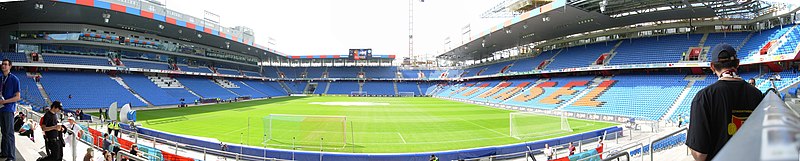 St. Jakob-Park was the biggest stadium in the Swiss country that was the post from the club of FC Basel. This stadium initially only had a capacity of 38,500 seats but because St. Jakob-Park will eventually be used for the EURO match his 2008 capacities were increased to 42,500 seats. This stadium beforehand had been renovated and opened again on March 15 2001. This stadium had approximately 32 shops diolantai that was different and was met 2 restaurant that is "Restaurant UNO" and "Hattrick Sports Bar". In EURO 2008, St. Jakob-Park will be used for 3 matches that is 2 quarter final matches and 1 semi-final match.
The STADIUM for the EURO PRETEXT
 The stadium that was used for the EURO pretext 2008 was 8. 4 stadiums in Swiss and 4 stadiums in Austria. Swiss stadium are : St. Jakob-Park; Stade de Suisse,Wankdorf; Stade de Genève and Letzigrund Stadium. Austria stadium are : Tivoli-Neu Stadion; Wörthersee Stadion; Wals Siezenheim Stadium; Ernst Happel Stadion.
 The MASCOT
 Twins's mascot EURO 2008 was officially given by the Trix name and Flix on October 10 2007. The Trix name and Flix were chosen by more than 67 Austrian residents and Swiss. But this name election was carried out since September 27 2006 through the internet or direct continuation that was operated through telekom Austria. This mascot wore the costume with number that was different that is 20 and 08 that symbolised typical, the self-confidence, serious, rebels and creative.
ABOUT EURO 2008
 The big pretext of the international football championship the country would have been spread out on June 7-29 2008. This international European championship of world football was known with EURO to be spread out in 2 different countries that is Austria and Swiss. This the second EURO time was spread out in 2 different countries after last 2000 was spread out in the Netherlands-Belgium. EURO 2008 will bring together 16 European countries, participants's 2 countries EURO 2008 was Swiss and Austria that became the place host was held by this great pretext, whereas 14 other countries must through the qualification round before.